The U.S. Department of Energy issued an emergency order for the PJM region on October 12, 2026, under section 202(c) of the Federal Power Act. It is numbered 202-26-50 and captioned "Regarding Specified and Backup Generation Resources." A footnote says PJM serves as the region's Reliability Coordinator and Balancing Authority, responsible for overseeing the dispatch of generation to meet demand at all times within the limits of the transmission system. The order's first paragraph determines "that a statutory emergency exists" in the region, due to a sudden increase in demand, or a shortage of electric energy or of the facilities to generate or transmit it, "and other causes."
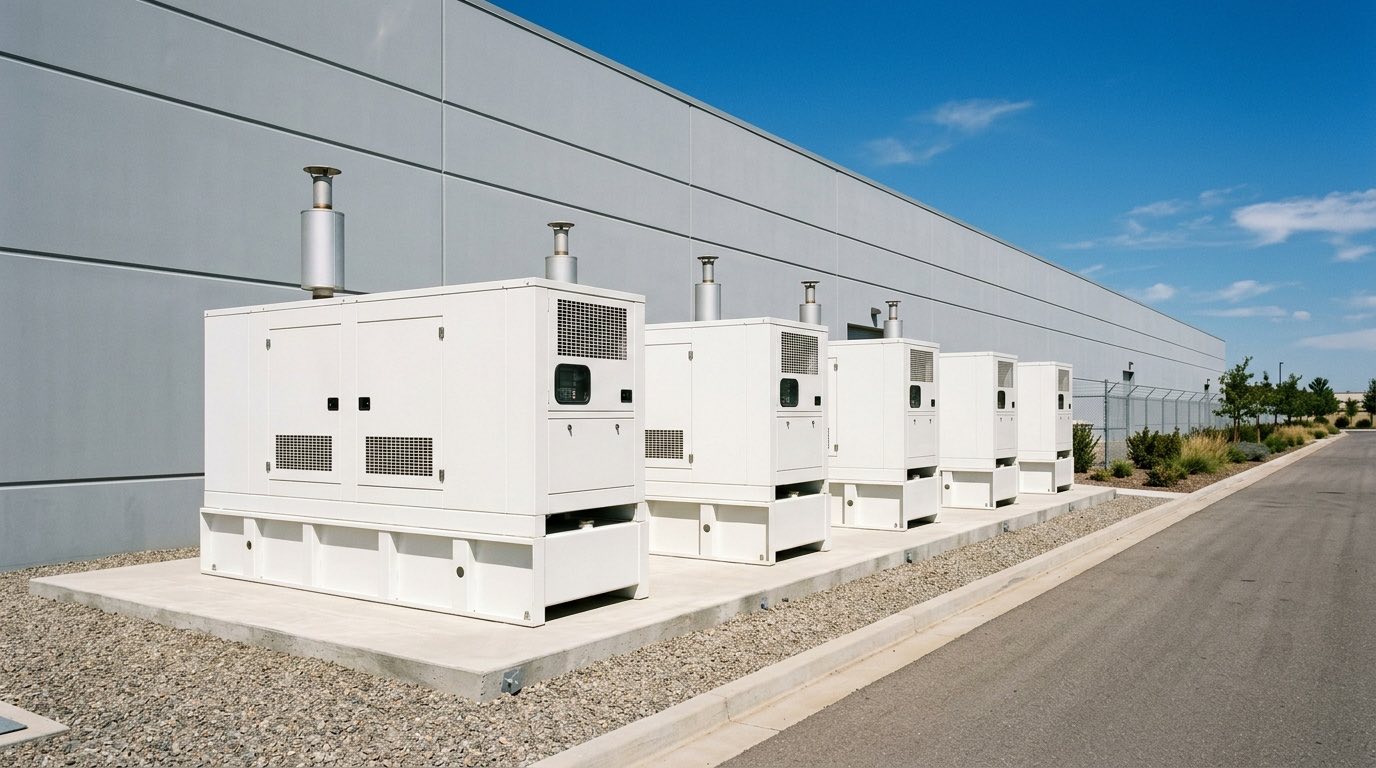
The caption names two kinds of resource. "Specified Resources" are the generating units on a list PJM attached to its request. The other kind is backup generation, and that is where data centers come in. In the department's understanding of the request, PJM seeks to deploy backup generation resources "at data centers (including, but not limited to, hyperscaler facilities) and at other large load industrial and commercial customer sites."
What PJM reported
PJM asked for the order on October 11, 2026. By the order's account, it forecast demand at or around 111,500 MW, "or higher", for October 13. For October 14 it reported that "PJM is forecasted to be within 900 MW of its reserve margin," with generation outages expected to reach 61,591 MW across its system. The order names the zones with "the most acute issues."
PJM reports that conditions are being driven by three things. Demand is elevated, the rate of generation outages is high "due to planned outages during the autumn outage season", and there are "numerous planned transmission outages." The order also notes anticipated transfer issues, north to south and west to east, that could limit how much generation can be delivered. PJM itself said it "will commit all available generation resources across its footprint to support reliability on October 13 and October 14," and that it was evaluating emergency actions such as recalling off-system sales and deploying demand response. Its request was for an order effective October 13 through October 16, 2026, "the expected period to reduce the need for any firm load shedding during emergency system conditions."
Backup generators, as a last resort
An EEA is an Energy Emergency Alert. The order quotes parts of NERC Reliability Standard EOP-011-4, which "addresses Emergency Operations." An alert "may be initiated only by a Reliability Coordinator," which in this region is PJM, and "NERC has established three levels of EEAs." Before it asks for the third, an energy deficient Balancing Authority "must make use of all available resources." In paragraph B, the order explains the point before an EEA 3 as "before firm load interruption."
PJM's request reached beyond the listed generating units. By the order's account, it sought authority to direct backup generation at large loads and to use it "instead of grid power during or as a last resort before or during declaring a PJM-wide or local EEA 3 event." In the order's words, using this backup generation "is expected to reduce stress on the grid and permit orderly, safe, and secure operations during the emergency conditions."
The order's lettered paragraphs run from A to L. Those reported here keep their letters, starting with the four on what is dispatched, what is run and what is spared.
- Paragraph A begins "From October 13, 2026, in the event that PJM determines that generation from the Specified Resources is necessary to meet the electricity demand that PJM anticipates in its service territory," and directs PJM to dispatch such unit or units "and to order their operation only as needed to maintain reliability." It adds that "Specified Resources are those generating units set forth in Exhibit A to its Application for this Order," a list it makes "subject to updates directed here and as described in paragraph G."
- Paragraph B: "From October 13, 2026, PJM is authorized to direct backup generation resources (whether auxiliary, standby, directly-connected, battery storage, or other, and whether synchronized or not to the bulk power system) to operate as a last resort before declaring an EEA 3 (i.e., before firm load interruption) or during an EEA 3."
- Paragraph C: "This Order requires the operation of the backup generation resources described in paragraph B. Following the conclusion of the EEA conditions described in paragraph B, sufficient time for orderly ramp down is permitted, consistent with industry practices."
- Paragraph D: "This Order is not applicable to any backup generation resource serving a critical reliability or backup need, including those at defense, homeland security, first responder, air traffic control, hospital facilities, 911 call centers, water treatment or wastewater facilities, natural gas pipeline facilities, natural gas gathering facilities, or other similar facilities."
Paragraph D spares backup units that serve "a critical reliability or backup need", and its list of examples has no data center on it. Whether a campus can count itself among the "other similar facilities" is left open by the order.
Permits, and payment
PJM anticipates that the order "may result in exceedance of permit restrictions" on sulfur dioxide, nitrogen oxide, carbon monoxide, wastewater release and other air pollutants, including ammonia, and on other limits such as fuel throughput. It also asked that the order allow "use of backup generation by large loads notwithstanding any applicable environmental limitations under federal, state, or local law or regulation."
The order sets terms of its own. It limits the operation of dispatched units "to the times and within the parameters determined by PJM for reliability purposes." While it is in effect, the emissions, hours of operation and fuel burned by both kinds of resource "will not be counted toward applicable rolling-average based limitations." Three of its paragraphs speak to compliance and to cost.
- Paragraph F: "All operations of the Specified Resources and backup generation resources must comply with applicable environmental requirements, including but not limited to monitoring, reporting, and recordkeeping requirements, to the maximum extent practicable while operating consistent with the emergency conditions."
- Paragraph I: "Each party affected by this Order is directed to file with the Federal Energy Regulatory Commission any tariff, tariff revisions or waivers necessary to effectuate this Order, as applicable. Rate recovery is available pursuant to 16 U.S.C. § 824a(c)."
- Paragraph J: "This Order shall not preclude the need for the Specified Resources and backup generation resources to comply with applicable state, local, or Federal law or regulations following the expiration of this Order."
Paragraph I points to filings and to rate recovery, and the order says nothing more about payment. For a data center whose backup sets run for the grid, who pays for the fuel and the hours is a question to settle in writing.
Not capacity, and dated
Paragraph K draws a line around the backup units, and it gives its own reason: the order "is predicated on the shortage of facilities for generation of electric energy and other causes." Paragraph L sets the dates, which are the dates PJM asked for, and makes two exceptions to them, the reporting requirements of paragraph E and the compliance obligations of paragraph F. Under paragraph E, PJM is to send the department a daily notification of each unit that was designated to use the order's allowance and operated in reliance on it.
- Paragraph K: "Because this Order is predicated on the shortage of facilities for generation of electric energy and other causes, any backup generation resource subject to this Order shall not be considered a capacity resource."
- Paragraph L: "This Order shall be effective October 13 through October 16, 2026, with the exception of the reporting requirements in paragraph E and applicable compliance obligations in paragraph F. Renewal of this Order, should it be needed, must be requested before this Order expires."
Called on, but not counted. Under paragraphs B, C and K, a campus's backup generators can be run for the grid in this emergency and still gain no standing as capacity, and the authority the order gives ends on a printed date, with renewal only on a request made before then.
Sources
- U.S. Department of Energy. Order No. 202-26-50: PJM Interconnection, L.L.C., Regarding Specified and Backup Generation Resources. 12 October 2026. energy agency