On October 7, 2026, the Indiana Utility Regulatory Commission approved, in an order of 31 pages, a utility's petition for "approval of a project to serve a large load customer and associated relief." The customer is a company's subsidiary with a planned data center site in Monrovia, Indiana. Parts of the order follow, not the whole. The utility, the customer, the resources and the people in the case are not named here.
The Project
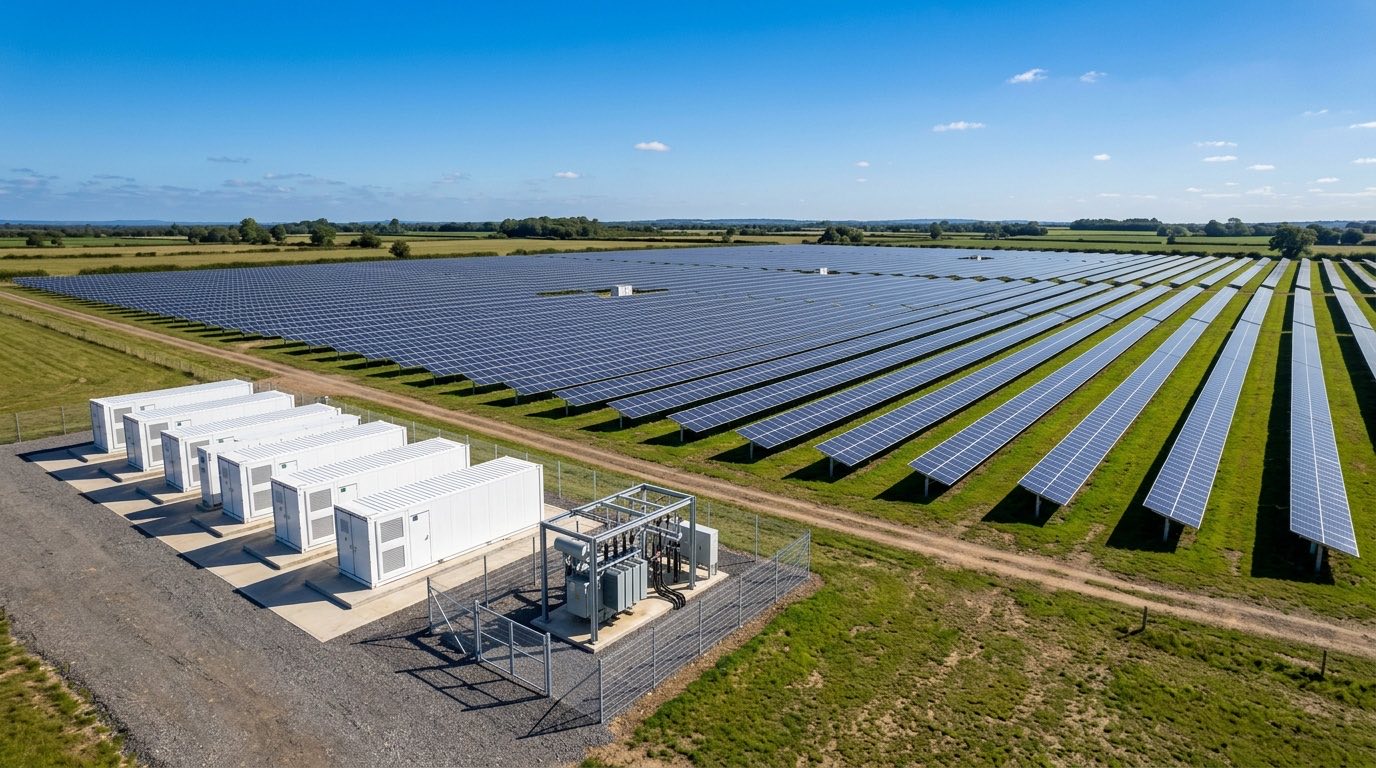
The utility proposed to acquire, through subsidiaries, two stand-alone battery energy storage systems and a hybrid solar plus storage resource, "primarily to provide the requisite incremental energy and capacity to serve" the customer at its planned data center site. One battery is 200 MW, the other 130 MW, and the hybrid pairs a 130 MW solar facility with a 130 MW battery. A witness for the utility testified that the resources "will add 460 MW of dispatchable 4-hour storage resources by 2030."
The estimated Project Cost is $737.3 million, "including the estimated tax equity contribution." By the testimony, the cost estimates for the resources came from the utility's "recent competitive All-Source RFP process and negotiation with the developers." The commission found the estimated Project Cost reasonable, noting that while other parties "raised concerns about ratemaking cost allocation, no party directly challenged the reasonableness of the Project Cost estimates."
A witness for the utility explained that while the customer's parent company "has expressed an interest in developing new generation resources," none "were considered practical to integrate into the facility at this time." The customer, it says, "expressed an interest in relying on" the utility to serve its load through the new resources. By the testimony, the utility serves the customer with its system as a whole, under a "slice of system" approach.
The Law's Tests
Under chapter 8-1-7.9 of the Indiana Code, the order says, an energy utility "may seek expedited Commission approval of energy infrastructure and generation resource projects to serve large load customers." To approve one, the commission must find that the utility's information is complete, that reasonable and demonstrable consideration was given to non-generation alternatives, that existing and future customers "will be adequately protected if the request is granted," and that the utility has considered the effect on the preferred resource portfolio in its most recent integrated resource plan.
Among the conditions for filing such a petition, the large load customer must commit to "certain significant and meaningful financial assurances." Here, the order finds, they "include reimbursement by the large load customer of at least 80% of the project costs reasonably allocated to the Customer," and protect the utility's other customers from those costs "regardless of whether the Customer ultimately takes service in the anticipated amount and within the anticipated time frame."
Who Pays for What
Under the construction service agreement, the customer "is responsible for all the direct connect costs" and pays for them upfront during construction, regardless, the order says, of whether it "ultimately takes service for the anticipated amount and within the anticipated time frame." A witness for the utility explained that the rates in the electric service agreement are designed so that the customer's payments "reimburse at least 100% of the Project's annual costs (both transmission and generation), even at the Customer's minimum monthly demand."
A witness for one of the intervenors recommended that the costs of upgrading the transmission network be assigned directly to the customer. The commission did not agree. Network upgrades, it found, are "intended to provide reliability, resiliency, and stability to the system at large," so it is reasonable for them "to be treated as overall transmission assets serving all customers." The order adds that the network upgrades are "a component of the Customer's incremental fixed costs and will be recovered at the Customer's minimum monthly demand." Cost of service and rate design, it notes, can be assessed in the utility's next base rate case, "which is expected to be filed in 2029," when the utility will have actual load data for the customer.
The protections the commission found rest on the customer's own contracts. How they hold up is what the next rate case, with real load data behind it, can show.
Sources
- Indiana Utility Regulatory Commission. Order of the Commission, Cause No. 46394: petition for approval of a project required primarily to serve a large load customer, customer-specific arrangements, an alternative regulatory plan, and associated accounting and ratemaking. 7 October 2026. regulator