ERCOT held a workshop on October 6, 2026, on curtailing large loads under a law known as SB6. Its slides note that a significant number of new large loads are pursuing interconnection in the ERCOT region. As they are added, "generation supply may not always keep pace with the system demand."
SB6 gave ERCOT new authority to direct the curtailment of certain large loads, to protect grid reliability. The slides are for the first of what ERCOT says will likely be a series of workshops. Their stated goal is to build a shared understanding of the operational challenges, and to frame the questions ahead. Parts of them follow, not the whole.
Two Kinds of Curtailable Load
The slides describe two kinds of large load that the law made curtailable. The first is a large load in a net metering arrangement with an existing generation or energy storage resource, under conditions the Commission approves. To date, the slides say, the Commission has approved three such arrangements, all with substantially similar conditions. Under those conditions, curtailment can be ordered ahead of an emergency or during one, and the load must fully curtail within 30 minutes.
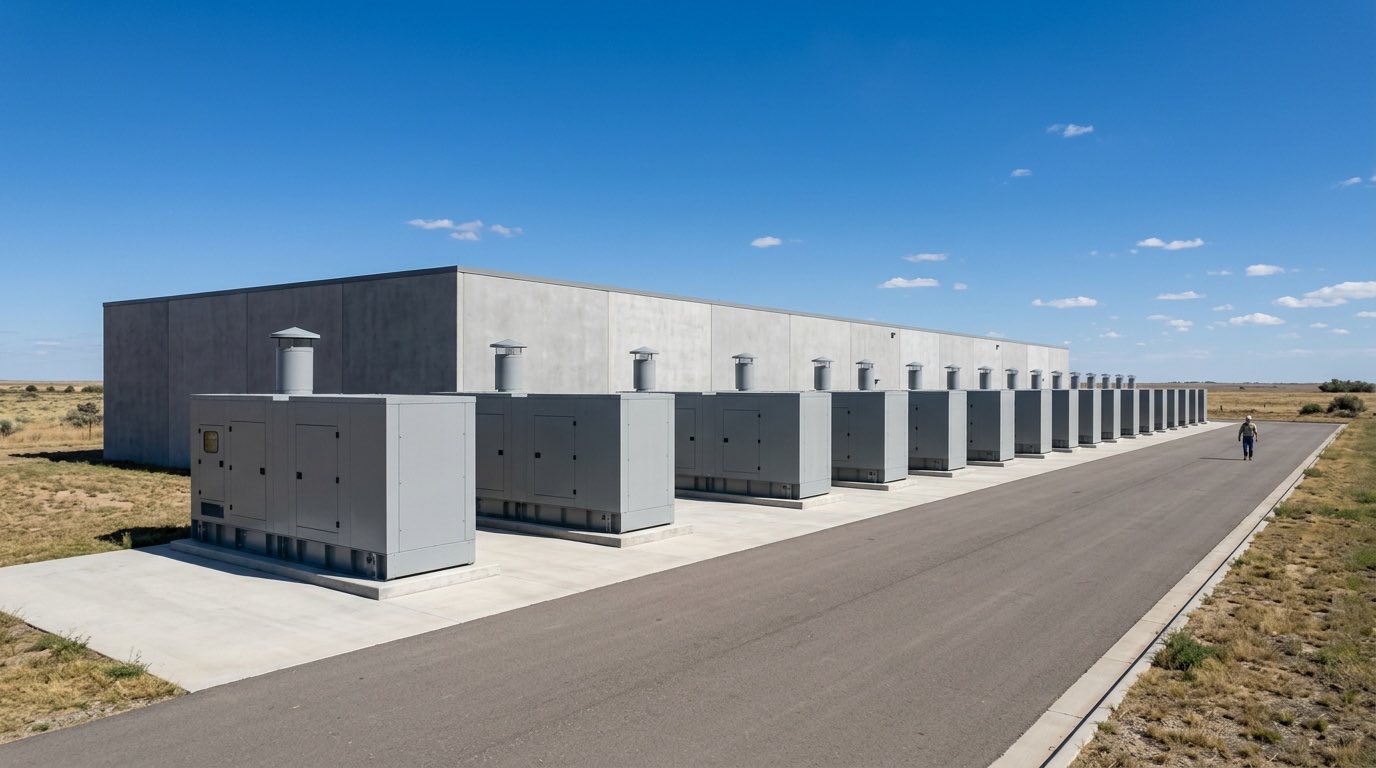
ERCOT calls the second kind a Backup-Supported Curtailable Load. It is a large load that can be served by on-site backup generation sufficient for at least 50% of the facility's total demand.
For this kind, the slides say, the law imposes two key conditions. ERCOT may act only after it "deploys all available market services, except for frequency responsive services." It may then direct the electric utility to require the customer to deploy its on-site backup generation or curtail load. The slides say one key goal of that language was to ensure large load additions do not increase the risk of firm load shed for residential and other customers.
Why the Timing Matters
ERCOT declares an energy emergency alert when its real-time operating margin falls below set levels. Level 1 starts below 2,500 MW. Level 2 starts below 2,000 MW. At Level 3, below 1,500 MW, ERCOT may order firm load shed. The slides say they use "operating margin" as a common term for headroom or reserves on the system broadly, "rather than as a precise metric."
If ERCOT could be certain that the margin would always fall slowly, and that there would always be enough time to take load off carefully, the slides say, the law's curtailment could in theory map onto those levels: the net-metered loads no later than Level 1, the backup-supported loads at Level 2. But "operating margin will not always decline slowly, and curtailment takes time." Instructions take time to issue and to carry out. As loads grow in number and size, more coordination may be needed. And curtailing too much load at once risks high system frequency, so ERCOT may need to curtail in smaller steps, which takes longer. Waiting for the margin to reach a threshold, the slides say, may not leave enough time to use all the curtailment the law allows before firm load shed is needed to maintain frequency or NERC contingency reserves.
The Utility in the Middle
Under the law, ERCOT instructs the utility, which then coordinates with the customer. That adds a step, which the slides say can lengthen the response or shorten the time the load has to act. With the sizes of individual large loads now being proposed, they say, meeting a target will increasingly mean partial, block-level curtailment across many large loads. "The more detailed the instructions, the greater the risk of miscommunication as they are relayed."
A Simplified Example
The slides compare two cases under the same assumed system conditions, with the same 30-minute response time for each instructed block, in an example ERCOT calls "highly simplified." In its words, it is "not an actual event, an ERCOT forecast, or a study result." The two cases differ in when ERCOT begins instructing the backup-supported loads, and in whether it can see each load. In one case, ERCOT starts curtailing the backup-supported loads only once the margin is already low, as the law's timing has it, and cannot see each load's response. That case reaches Level 3 and firm load shed. In the other, ERCOT starts earlier on a near-term forecast and can see each load. That case stays above Level 3.
What ERCOT Says Would Be Needed
The slides say any way of carrying out the backup-supported curtailment needs to satisfy three operational requirements. Start instructions in time. Keep the response time as short as practicable. And make each load deliver the requested cut, with ERCOT able to see and confirm it.
Meeting those requirements, the slides say, depends on ERCOT knowing each load and on each load being obligated to respond. Possible rule changes would need three things. Each curtailable large load would register, giving ERCOT information including its location, its curtailment capability and its real-time consumption. Each instruction would carry a binding obligation to act, with a backstop. And there would be a clear response time. Each load would be added to ERCOT's operations model.
Limits, and What Comes Next
Those changes, the slides say, would improve precision and accountability. But they "do not change when ERCOT may act" under the law, or whom it directs. In a middle case of the same example, with registration but with the law's timing, firm load shed still occurs.
The slides also look ahead to reliability standards NERC is developing for computational load sites of 50 MW or more, served at 100 kV or above. ERCOT's current large load threshold is 75 MW. If FERC approves them, ERCOT suggests one set of rule changes could meet both those requirements and the law's curtailment needs.
ERCOT asked for feedback on the possible rule changes, and on two related topics, by October 23, 2026, and said a follow-up workshop would be scheduled in early November. It will consider the feedback before it finalizes its revision requests.
Sources
- Electric Reliability Council of Texas (ERCOT). SB6 Large Load Curtailment Operations Workshop #1 (workshop slides). 6 October 2026. grid operator