NERC, the North American Electric Reliability Corporation, published an incident review on January 8, 2025, titled "Considering Simultaneous Voltage-Sensitive Load Reductions." It looks at one event in the Eastern Interconnection, in which "A 230 kV transmission line fault led to customer-initiated simultaneous loss of approximately 1,500 MW of voltage-sensitive load that was not anticipated by the BES operators," BES being the Bulk Electric System. All of that load, the review says, was "exclusively data center-type load." And the grid, it says, "has historically been planned for large generation losses but not for such significant simultaneous load losses." Parts of the review follow, not the whole.
Six Faults, Cleared Properly
At approximately 7:00 p.m. Eastern on July 10, 2024, a lightning arrestor failed on a 230 kV transmission line. The fault was permanent, and the line was eventually, in the review's own quotation marks, "locked out." The line's auto-reclosing control was set for three attempts, staggered at each end. "This configuration resulted in 6 successive system faults in an 82-second period. The protection system detected these faults and cleared them properly." The shortest lasted 42 milliseconds and the longest 66.
"None of this load was disconnected from the system by utility equipment; rather, the load was disconnected on the customer side by customer protection and controls." The area where it happened, the review says, "has a high concentration of data center loads."
With the load gone, frequency and voltage rose. Frequency reached a high of 60.047 Hz and settled back to 60.0 Hz in approximately 4 minutes, and voltage rose to 1.07 per unit. Operators removed shunt capacitor banks in the local area to bring voltages back to normal. "In this incident, the frequency did not rise to a level high enough to cause concern," the review says, and voltage did not reach levels that posed a reliability risk, though operators had to act to bring it down. "However, as the potential for this type of load loss increases, the risk for frequency and voltage issues also increases."
Why the Load Left
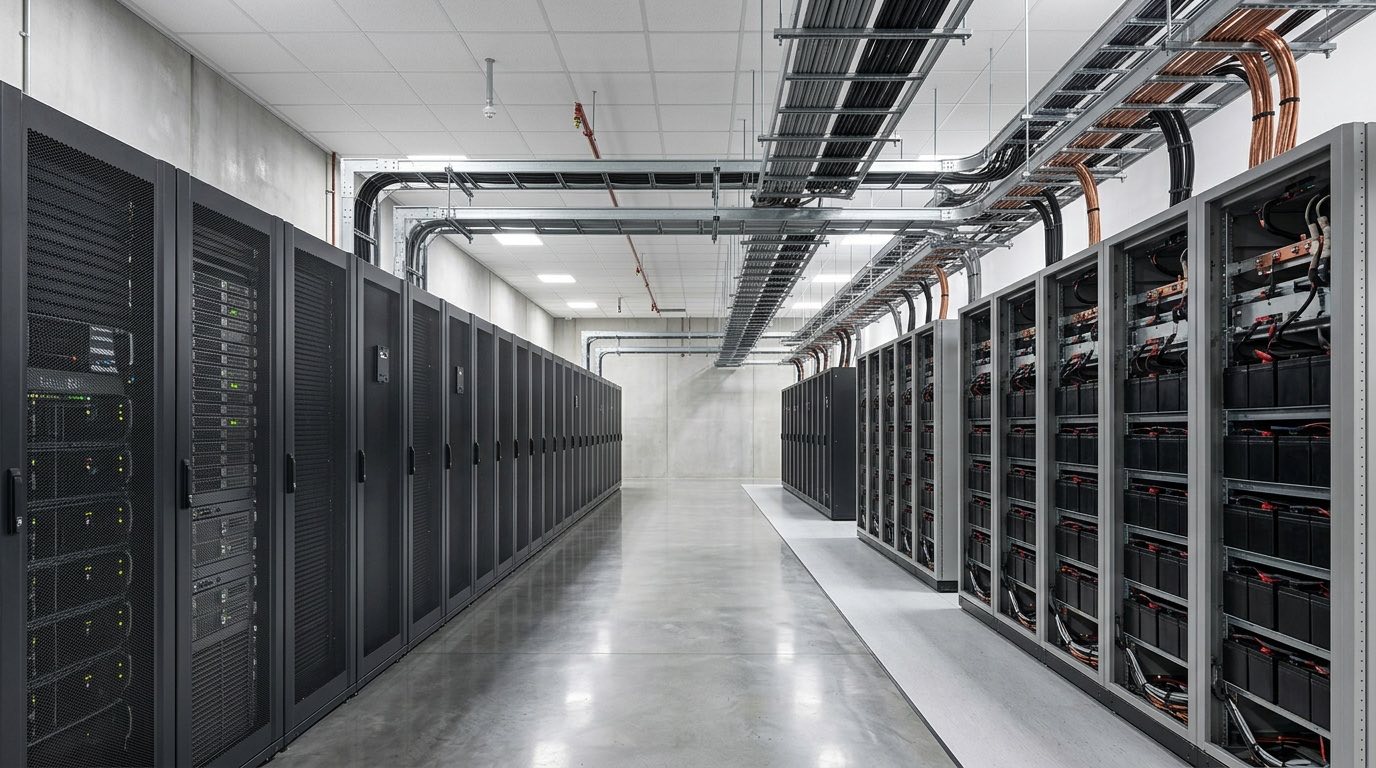
Discussions were held with the data center owners. "It was determined that the data centers transferred their loads to their backup power systems in response to the disturbance." To ride through disturbances on the grid, the review says, data centers use uninterruptible power supply systems, or UPS, "that will instantaneously take over providing power to the data center equipment when a grid disturbance occurs."
The differing types and designs of these systems, the review says, "cause differences in the characteristics of the data center responses to a voltage disturbance." A static UPS switches the load to batteries, and once grid voltage returns to normal the load is transferred back. A rotary one, which the review calls DRUPS, uses a flywheel and starts a diesel engine, and it "will not quickly transfer the load back to the grid after the transient disturbance has cleared." Typically, the review says, that transfer back "must be done manually."
Another scheme counts. It "detects and counts voltage disturbances on the grid," and if it sees a certain number within a certain time, the data center moves its load to the backup system and stays there until it is manually reconnected. "The typical number of voltage disturbances that trigger this scheme is three, and a typical time is one minute." These three load characteristics were predominant in this event, but "many load characteristic variations exist," set by vendor equipment controls and by "controls under the purview of data center owner/operators."
"Most of the sustained load reduction occurred simultaneously with the third voltage depression, which coincided with the third automatic reclosing attempt," the review finds. "At that time, approximately 1,260 MW of load dropped off the electric grid and did not return for hours." Most of the load loss, it says, "can be attributed to the interaction between the automatic reclosing sequence on the faulted transmission line and the data center's protection/control scheme that counts the number of voltage disturbances within a specified period of time."
A counting setting chosen inside the fence met a reclosing sequence chosen outside it. For whoever builds or finances a campus, how the backup system is set is a question the grid's planners have reason to ask too.
Questions That Must Be Resolved
The incident "did not present any significant issues with the reconnection of the large loads," the review says, but "the potential exists for issues in future incidents if the load is not reconnected in a controlled manner." In its words, "Ramp rates for load connection are just as critical to system operations as generation ramping." Similar incidents have occurred in other Interconnections with cryptocurrency mining loads and oil and gas loads, which the review says are different from these data center loads but "present the same challenges to the operators and planners of the BES."
Load that leaves together can come back together. A campus that reconnects without an agreed ramp rate hands the grid the same problem in reverse.
This disturbance "did not cause significant operating issues with the grid at this location and at this time," the review says, but "as data center loads continue to grow rapidly, the risk could quickly increase." It lists actions that transmission operators and planners should start taking: require dynamic response models of large loads in their facility interconnection requirements, study how much load could be lost in a fault, consider voltage-sensitive load loss when configuring automatic reclosing schemes, and monitor for load losses that come with faults. For transmission operators alone, it adds one more: make sure operating agreements with large loads include ramp rates for connecting and reconnecting them.
The list closes on "Critical questions that must be resolved." One is "Should large loads be a NERC registered entity?" Another asks, "What is the definition of a large load?"
Sources
- North American Electric Reliability Corporation (NERC). Incident Review: Considering Simultaneous Voltage-Sensitive Load Reductions. 8 January 2025. regulator