Utah has written water reporting for data centers into law. The enrolled copy of H.B. 76, from the Utah Legislature's 2026 General Session, is titled "Data Center Water Transparency Amendments," and its general description is one line, "This bill addresses reporting related to water use and large data centers." It enacts a new section of the Utah Code, 73-5-8.3, "Reporting by large data centers," which the Utah Code's page shows as "Enacted by Chapter 298, 2026 General Session." The bill "takes effect on May 6, 2026." It sets what an operator must report about water, to whom, and when.
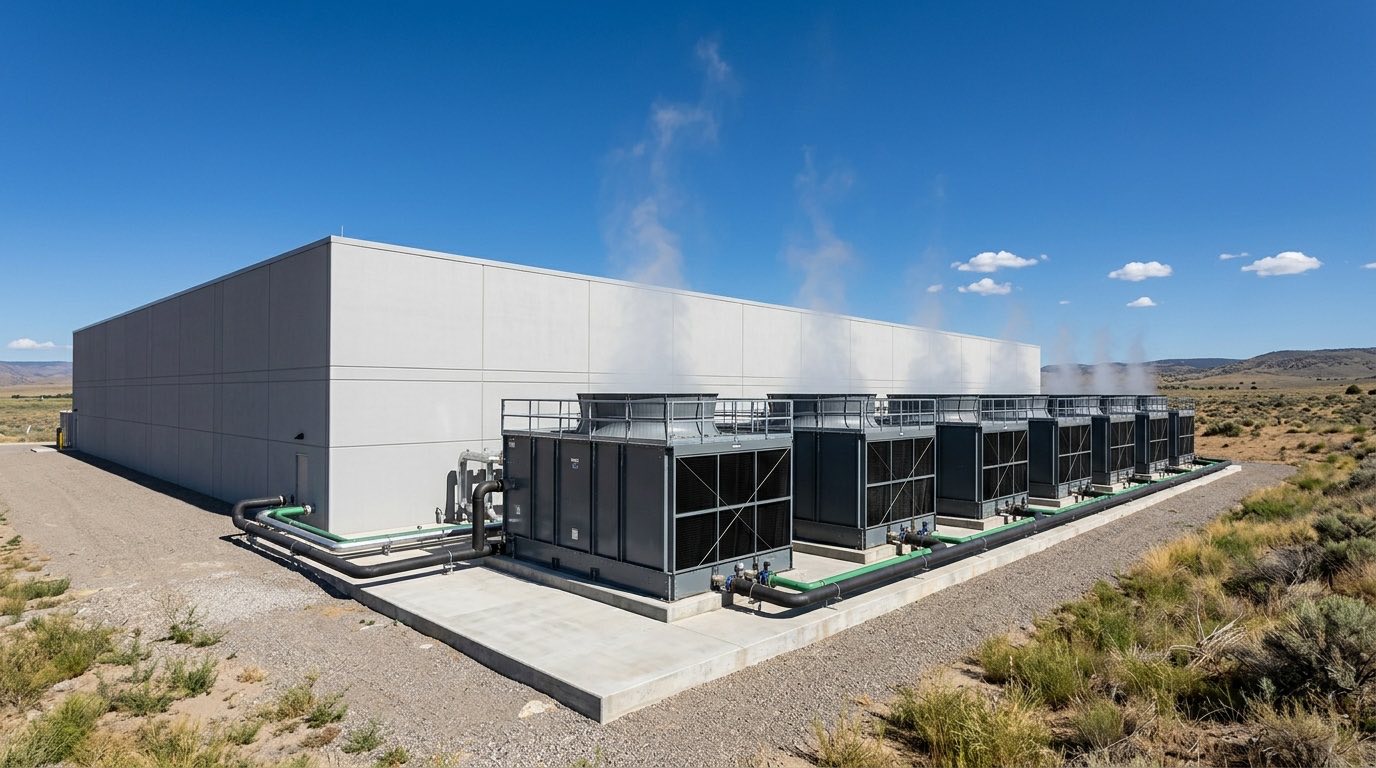
Which data centers
The law starts from water. A large data center is "a facility with an annual water withdrawal of 75 acre feet per year or more" that also meets five further tests. It houses networked servers in one physical location, whose primary service is to disseminate, manage and store data, and it "consists of one or more buildings that in total equals or exceeds 10,000 square feet." It has facilities for cooling, environmental control and security, or for generating its own energy, and both the facility and its land are owned or leased by the operator or by a person under common ownership with it.
The duties fall on new ones. A "new large data center" is "a large data center that begins operations on or after July 1, 2026."
The threshold is set in water withdrawn, not in megawatts. A campus that withdraws little water may fall outside the law, whatever its size in power.
Before approval, and before construction
"Before a land use authority of a municipality or county approves a land use application for a new large data center," the authority must notify the Division of Water Rights, the Division of Water Quality, and "the relevant water provider, if any." From July 1, 2026, the operator has its own window, "at least 90 days, but no sooner than 360 days, before" it begins construction activities.
In that window the operator must tell the water provider in writing what water the center expects to need, "so that the water provider can determine whether the anticipated water consumption of the new large data center is compatible with the location in which the new large data center is being located." It must also report to the division where the center will be, "the estimated withdrawal amount of water that the new large data center will withdraw annually," its plans to treat discharges, if any, whether it will adjust the temperature of what it discharges, and whether it will reuse or replace the water it uses.
Every year after
Once a new large data center is running, the reporting becomes yearly. The operator reports its efforts to reduce water consumption, its "actual withdrawals for the calendar year," its efforts, where they apply, to protect the environment and the public from polluted water, and anything else the division requires by rule. It reports "annually by no later than July 1" and "for the previous calendar year," "unless the state engineer requires the new large data center to report water data by rule made in accordance with Title 63G, Chapter 3, Utah Administrative Rulemaking Act, under a statute other than this section regardless of whether the scope of the report required by rule includes all water data for the new large data center."
What becomes public
The withdrawals do. "The division shall publish water withdrawal data for each new large data center that is reported under Subsection (3)(b) or (4)(a) on the division's public website by no later than September 1 for the previous calendar year, and not in the aggregate." Center by center.
Some of what is reported can be kept from the public. Where the operator complies with Section 63G-2-309, the division treats as a protected record what an operator reports about its plans for discharges and their temperature, its water reuse, its efforts to cut consumption and to protect against polluted water, and the other information required by rule where the division says, when it requires it, that it will treat it as protected. What the public gets of that is "aggregated and anonymized data," disclosed each year by September 1, "organized by county."
Each center's withdrawals become public, center by center. Its plans for discharge, temperature and reuse can be kept as protected records, and reach the public only as anonymized data by county.
Enforcement
The law has a fine behind it. If an operator "fails to submit a report required under Subsection (3) or (4) or submits an incomplete report," the division must tell it so. If a complete report still does not come, "the division shall impose a fine in accordance with Section 73-2-25 of up to $100 for each day the operator of the large data center fails to comply with this Subsection (6)."
Sources
- Utah State Legislature. H.B. 76, Data Center Water Transparency Amendments (enrolled copy, 2026 General Session). 6 May 2026, the day the enrolled copy says the bill takes effect. law
- Utah State Legislature. Utah Code 73-5-8.3, Reporting by large data centers. 2026 General Session. law