On January 9, 2026, EPA "finalized amendments to the New Source Performance Standards (NSPS) for Stationary Combustion Turbines and Stationary Gas Turbines," says a fact sheet from the agency. They set standards for two pollutants, nitrogen oxide and sulfur dioxide, written NOX and SO2, and they cover facilities "that commenced construction, modification, or reconstruction after December 13, 2024."
Stationary turbines, the fact sheet says, stand "at power plants and at industrial sources, such as pipeline compressor stations, chemical and manufacturing plants, oil fields, landfills, and institutional facilities, among others." They are used to produce electricity and to drive heavy equipment such as compressors. The fact sheet does not mention data centers. Parts of it follow, not the whole.
Size, Utilization and Efficiency
EPA sorts new, modified and reconstructed turbines by size, measured as base load rated heat input in million British thermal units per hour, or MMBtu/h. For new natural gas-fired turbines, its table calls a turbine large above 850 MMBtu/h and small at 50 MMBtu/h or less, with medium in between. The rule "further subdivides large and medium stationary combustion turbines by utilization level and large combustion turbines utilized at low levels by design efficiency."
To tell high- from low-utilization turbines, EPA will consider their 12-calendar-month capacity factor, "the amount of actual heat input divided by the total possible heat input." EPA set the line between low and high utilization at a capacity factor of 45 percent. For efficiency, EPA will use the manufacturers' design efficiency rating, with a threshold of 38 percent on a higher heating value (HHV) basis.
The fact sheet calls the best system of emissions reduction BSER. For most subcategories, EPA is keeping combustion controls as the BSER for limiting NOX. For new large turbines with high utilization rates, "(i.e., a 12-calendar-month capacity factor greater than 45 percent)," the BSER "is combustion controls with the addition of post-combustion selective catalytic reduction (SCR)." The table gives that class a NOX standard of 5 ppm. Large turbines utilized at low levels have standards of 25 ppm at the higher efficiency and 9 ppm at the lower.
A footnote to the table says its hourly standards "are based on firing natural gas and hourly operations at greater than 70% of the base load rating." It adds that "Separate standards exist when firing non-natural gas fuels and operating at part loads."
For a large new turbine, the utilization line decides whether its NOX standard rests on SCR. A plan to use it above that line is also a plan for that equipment.
Temporary Turbines
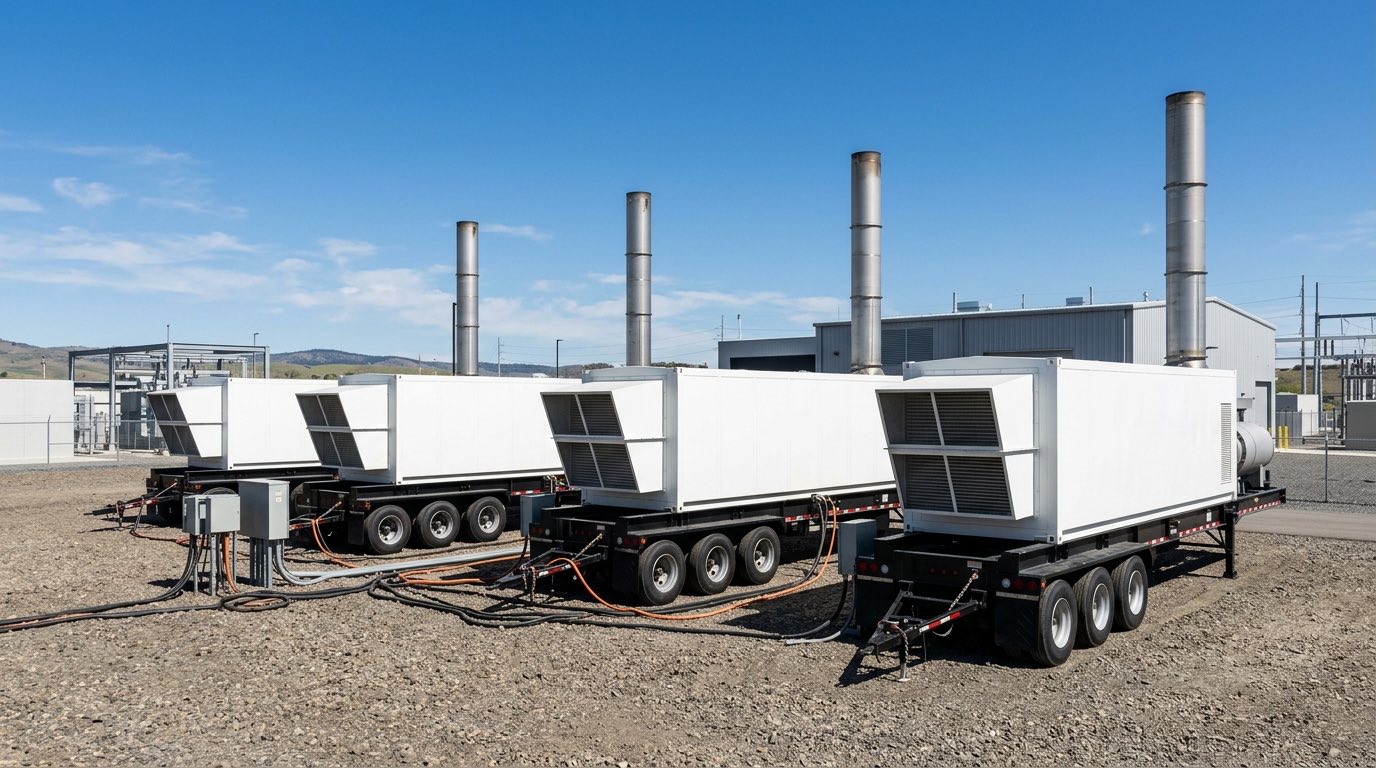
The rule adds a subcategory for stationary temporary turbines, which "applies to small and medium stationary combustion turbines (i.e., up to 850 MMBtu/h) used in temporary applications." Such turbines, the fact sheet's background says, "are generally operated in short-term situations but can also provide power during emergencies (e.g., natural disasters) while the primary generating equipment is not available, transmission and/or generation capacity is being repaired and/or upgraded, or for some unforeseen event."
A temporary turbine "that remains in place for longer than 24 months would not be considered temporary for any period of its operation," and any failure to comply with the requirements that would otherwise apply "would be an enforceable violation of the CAA," the Clean Air Act. Nor may one temporary turbine replace another to keep temporary status beyond the 24 months. Temporary turbines may, though, stand in for the generation of non-temporary turbines or other generators "when those units are taken offline (e.g., for maintenance work)."
Temporary turbines are subject to a BSER of combustion controls and a NOX standard of 25 ppm when firing natural gas. Their monitoring, recordkeeping and reporting requirements "are substantially reduced," which, the fact sheet says, "will also streamline the permitting process, which could otherwise in some cases exceed the length of time temporary power generation is needed." Annual performance testing is not required. The owner or operator must still keep on site documentation that each unit "has been certified by the manufacturer to meet a NOX emissions rate of 25 ppm and has been performance tested at least once in the prior 5 years (for turbines older than 5 years, after the initial sale by the manufacturer)." A separate provision "will allow portable combustion turbines regulated as title II-covered engines to be exempt from this NSPS as nonroad engines."
For a campus that runs on temporary turbines while it waits for a grid connection, that limit is a clock. Past it, a turbine is held to the requirements that would otherwise apply, for its whole time in place.
Estimates and Reviews
EPA estimates the final action "will result in net annual NOX emission reductions of up to 296 tons by 2032." It estimates cost savings for industry of up to $87 million over 8 years.
Under the Clean Air Act, the fact sheet says, EPA is required "to review and, if appropriate, revise, the standards every 8 years." It last revised this NSPS on July 6, 2006, "strengthening the NOX and SO2 standards."
Sources
- U.S. Environmental Protection Agency. Fact sheet: final amendments to the New Source Performance Standards for stationary combustion turbines (40 CFR Part 60, subpart KKKKa). January 2026. regulator