ERCOT, the Texas grid operator, publishes short papers it calls Trending Topics. This one, marked "Updated July 25, 2024," is about the Permian Basin region in West Texas, which the paper says "is continuing to experience tremendous load growth with increased oil and gas activity and the addition of large industrial and data facilities." "Primarily due to the significant projected loads in the Permian Basin region and the lack of sufficient local conventional generation to reliably serve demand around the clock," the paper says, "significant transmission lines will be needed to interconnect and import power to serve the forecasted load." Parts of the paper follow, not the whole.
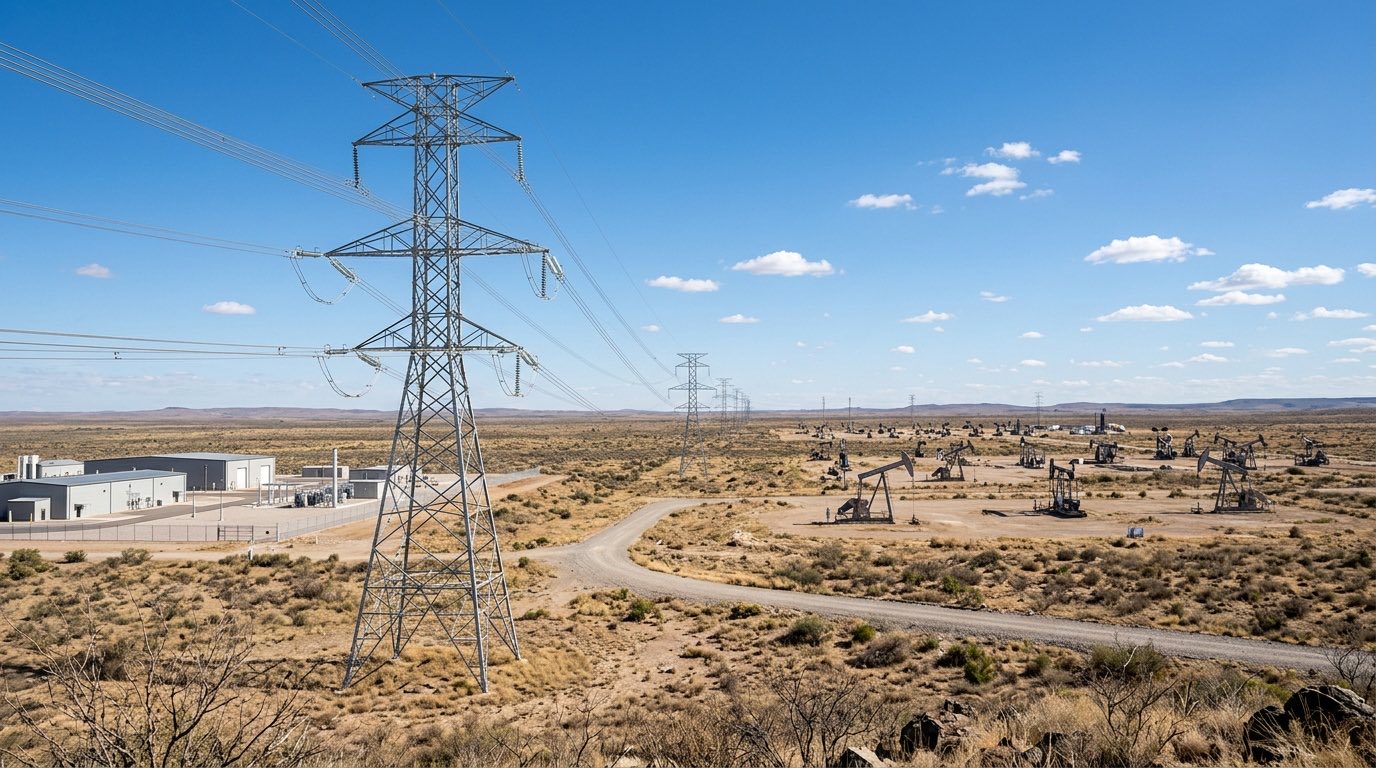
Where the Plan Comes From
Recent legislation, House Bill 5066, "required the Public Utility Commission of Texas (PUCT) to direct ERCOT to develop a reliability plan identifying the transmission facilities needed to serve existing and future demand in the Permian Basin region." On December 14, 2023, the PUCT ordered ERCOT to develop the plan and to file it by July 2024. ERCOT based it on load forecasts for 2030 and 2038 from the transmission and distribution service providers, and filed it on July 25, 2024.
Those providers, the paper says, supplied studies supporting a forecasted peak demand of oil and gas load of 11,964 MW in 2030 and 14,705 MW in 2038, "and an additional 11,695 MW of non-oil and gas load in the Permian Basin region in 2030." Its table puts the forecast total load at 23,659 MW in the plan's 2030 case and 26,400 MW in its 2038 case. The oil and gas row, a note to the table says, includes residential and commercial load.
Growth on that scale, in the paper's words, "would make the Permian Basin region in West Texas comparable (from an electricity demand perspective) to that of the ERCOT Gulf Coast (Houston, Galveston, Victoria) and North Central (Dallas-Fort Worth, Waco, Mineral Wells) weather zones." Transmission is "relatively sparse in the Delaware Basin subregion of the Permian, where oil and gas demand is shifting." Based on earlier studies, ERCOT has endorsed about $5.7 billion of transmission projects in the region since 2014.
A shortage of local generation, met with import lines, makes the day a line enters service the day that counts. For a campus in the region, that day sits with the steps that follow the plan.
Higher Voltage, Fewer Paths
With load forecast to grow across the state and generation changing in type and place, ERCOT widened its study to extra-high voltage lines, which it calls EHV. It "is considering new EHV transmission lines (765 kV single circuit or 500 kV double circuit) as an alternative to only adding new 345 kV transmission lines" in this plan and in its ERCOT-wide Regional Transmission Plan.
Whatever the voltage, a set of common local projects is needed, at a total cost estimate of approximately $4.02 billion for 2030 and 2038. For 2038, the paper's table puts the total cost estimate at $12.95 billion for the 345 kV option, $15.32 billion for the 500 kV option and $13.77 billion for the 765 kV option. "The short-term costs will be weighed against longer term benefits to support continued growth in Texas."
In 2038, the paper's comparison has 5 import paths required at 345 kV, 4 at 500 kV and 3 at 765 kV, needing 1,676 miles, 1,370 miles and 1,255 miles of new right-of-way, in the same order. For those miles, "A routing adder of 20% to the straight distance between two end points was assumed." Among the benefits of higher voltage, the paper lists "Reduced ROW impacts to consumers due to fewer new lines being needed."
Fewer import paths need fewer miles of new right-of-way, and the PUCT decides the routing of each one. For a developer waiting on power, miles to route may weigh as much as dollars.
What Comes Next
ERCOT filed the plan with the PUCT "for further review and consideration." "If the plan is approved, the PUCT will need to determine which TSPs are responsible for constructing the transmission infrastructure identified in the plan," the paper says, TSPs being transmission service providers. "Once that determination has been made, TSPs can then file the necessary applications for certificates of convenience and necessity (CCN) for approval with the PUCT."
In the paper's account of the planning process, the PUCT reviews and approves applications from TSPs for new transmission lines and determines their routing, and TSPs build, own, operate and maintain the lines. The paper is dated the day the plan was filed. It does not say what the PUCT decided.
Sources
- Electric Reliability Council of Texas (ERCOT). ERCOT Trending Topics: Reliability Plan for the Permian Basin Region. 25 July 2024. grid operator