Liberty Energy's presentation carries on its cover the words "Investor Presentation | March 2026," a month and no day. Part of it sets out the company's power business, Liberty Power Innovations, LPI, which a slide says "serves as a long-term energy infrastructure provider, delivering flexible solutions that prioritize speed to market, reliability, and predictable power prices." Its disclosures slide warns that its forward-looking statements are the company's current expectations or beliefs, and that "it is possible that the results described herein will not be achieved."
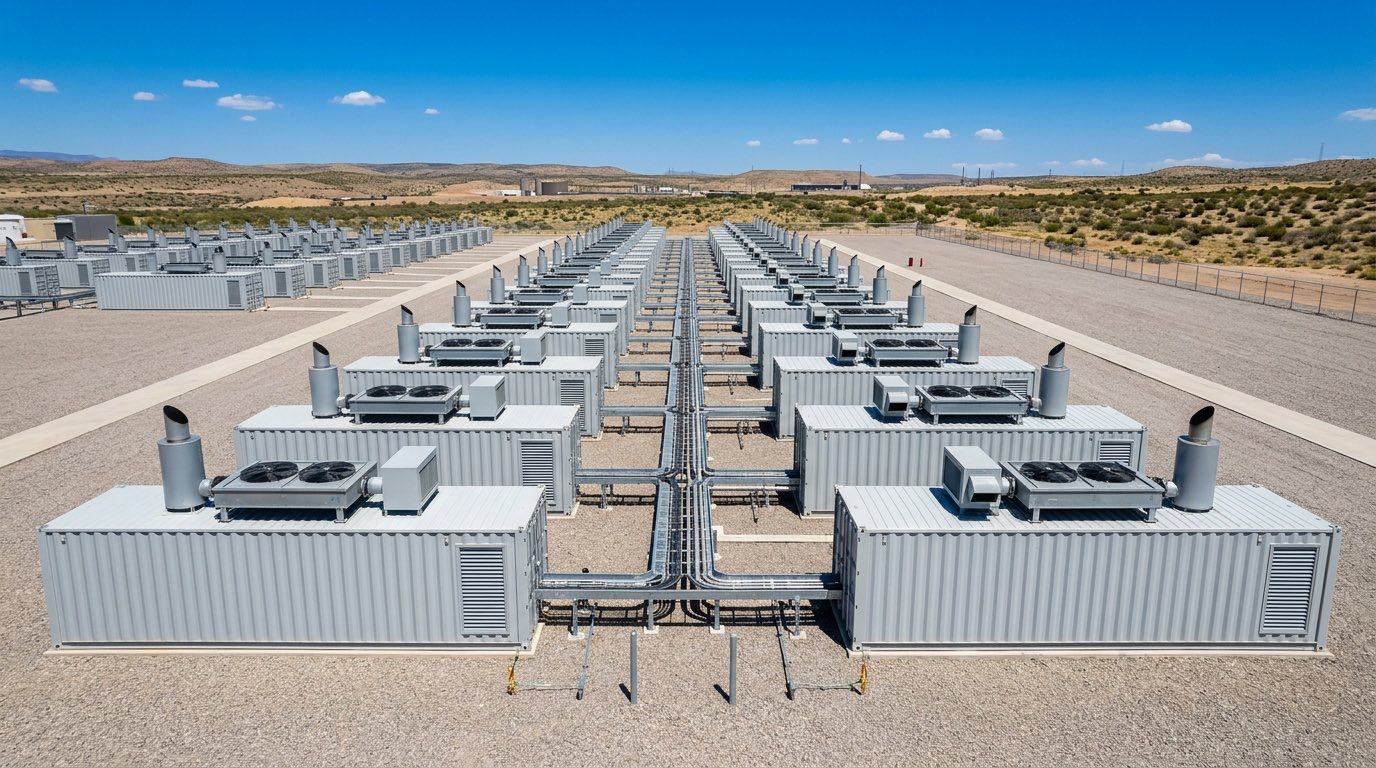
What LPI Offers
The company says LPI owns, operates and delivers power as a service, with a vertically integrated model that, it says, gives it control over engineering, design, development, construction, ownership and long-term operation of "distributed power assets tailored to each customer's needs." Under a point headed "Long Duration (~10+ Year) ESAs with End Users," the slide says that "Energy service agreements (ESAs) will be structured to deliver sustained, predictable earnings".
A slide titled "LPI: The Value Proposition" lists what it calls today's power constraints. One of them is "Timing uncertainty. No secure delivery time for grid power." Beside that list, a row labeled "FLEXIBILITY TO MATCH LOAD" says that modular, scalable systems "can match load curves and power densities," and that gas engines provide a flexible, quick-ramp response. Another, labeled "POWER PRICE SURETY," says that "Onsite assets lock in predictable, long-term energy costs (with fuel supply hedges or agreements), decoupling from volatile grid prices." The hedges and agreements are part of the claim, in the slide's own brackets.
An Illustrative Arrangement
A slide titled "LPI Illustrative Power Arrangement" is a diagram. Its labels include "Data Center Developer," "Hyperscale Load Demand," "LPI" and "Grid Integration." One label reads "10-15 Year Data Center Lease." Another reads "10-15 Year Initial ESA," and under it "Fixed Capacity Fee + Variable + Fuel." Labels on its arrows read "Provide power when needed," "Buy power when price is low" and "Sell excess power when price is high."
The slide gives no amount for the fee. It is illustrative, by its own title.
The slide sets a data center lease and an initial energy agreement side by side, each for a similar span of years. For a lender, the question is whether the two run together in practice, and what becomes of the fixed fee if the lease ends first.
Agreements and Reservations
The slide quoted at the start also has a point headed "Expanded Leading Data Center Developer & Hyperscaler Relationships", which says the company announced a 1 GW "power development agreement with" a data center developer the slide names, "anchored by a firm reservation contract on" 400 MW in 2027. The same point reports an agreement that ended early. A "Data center site expansion project related to" a 330 MW "power reservation agreement announced in Q126 was modified and delayed, resulting in early termination of the agreement; discussions are ongoing to support the developer with projects."
A later slide, titled "Advancing Together: Latest Power Platform Initiatives," gives the company's expected scale, a "Diverse portfolio of projects in the LPI pipeline and an execution plan to reach" 3 GW "of deployed power plants by 2029." On the agreement with the developer, it says LPI is to "Develop and deliver at least" 1 GW "of power between LPI and end-users of" the developer's "data centers by 2030, including a contracted reservation of" 400 MW "of 2027 power generation capacity."
The same deck shows a reservation that ended early because the project behind it was modified and delayed. A reservation is only as firm as the data center project it serves, and that is what a lender would test first.
Sources
- Liberty Energy Inc.. Liberty Energy: Investor Presentation, March 2026 (the company's own slides). March 2026. company results call