How much power does an AI data center draw, set against what it is built to draw? Existing power consumption data, says a paper titled "Measurement of Generative AI Workload Power Profiles for Whole-Facility Data Center Infrastructure Planning," "is largely proprietary." Its authors give one address, the National Laboratory of the Rockies in Golden, Colorado, and its first page carries the stamp "arXiv:2604.07345v1 [eess.SY] 8 Apr 2026". Using the laboratory's "high-performance computing data center equipped with NVIDIA H100 GPUs," they "measure power consumption of AI workloads at 0.1-second resolution for AI training, fine-tuning and inference jobs," publish the dataset, and then scale the measurements up to whole simulated data centers. Parts of the paper follow, not the whole.
The Hardware
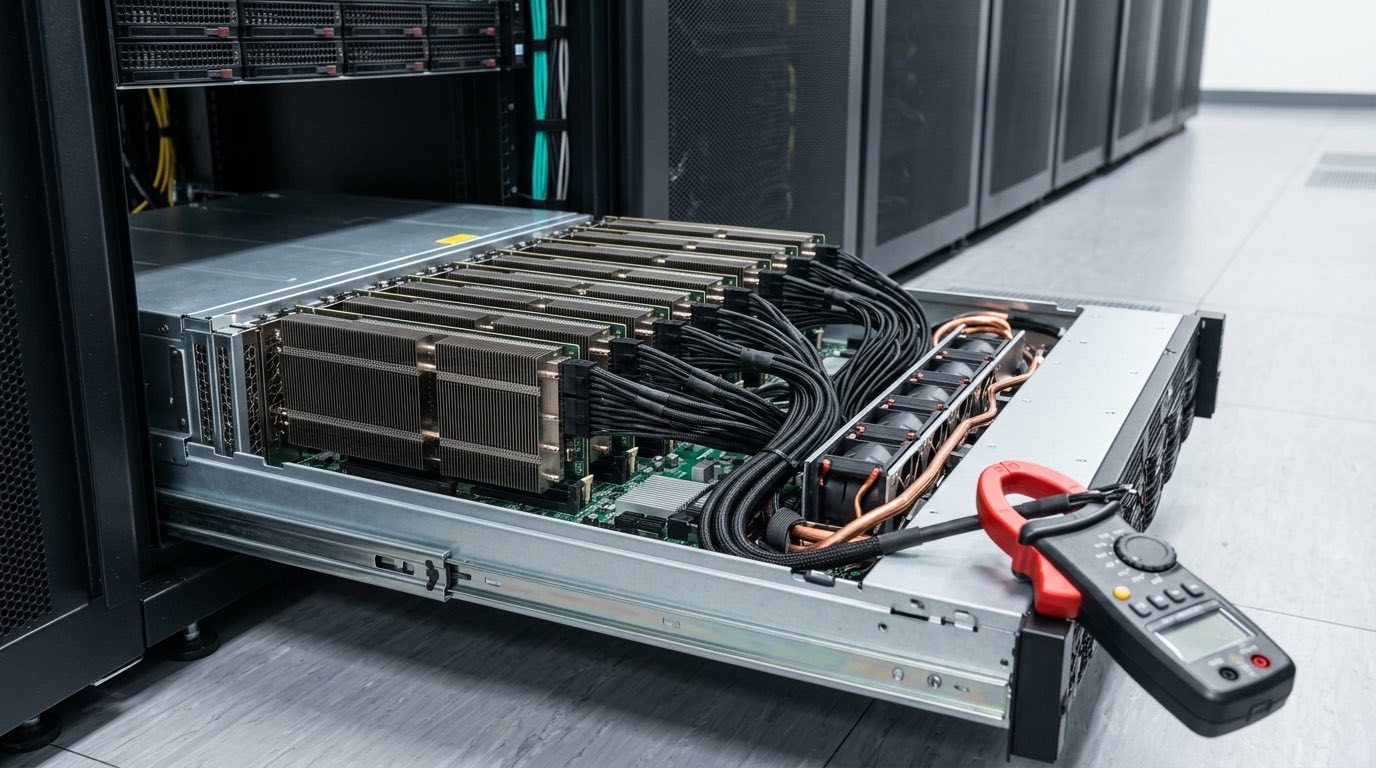
Every experiment ran on GPU nodes, "each housing four NVIDIA H100 SXM GPU accelerators." Both training and inference jobs, the conclusion says, "exhibit pronounced power transients that can vary widely according to the type of model and the number of nodes used for computation."
For "LLM and image-generation training workloads," power scaled linearly with the number of nodes, under the configurations tested. For online inference, server-level power "seemed to saturate at relatively modest request rates," which the paper says highlights that performance might affect power in a diminishing way beyond certain operating points.
Swings like these land on whatever supplies the power. A campus on its own generation has no grid to absorb them, so its plant has to follow the load as it moves.
Two Simulated Data Centers
The first simulation is of "a 10 MW colocation data center running a mix of AI training and fine-tuning jobs," built from the paper's own job measurements and from utilization patterns adapted from job data measured at a data center used to develop new AI models, with monthly data from the laboratory's own system to account for seasonality, over one simulated year. The facility is sized for 10 MW "not including cooling and auxiliary loads." In most of the simulations, all nodes were in use at once at some point. Even so, power "only reached a maximum" of about 7.30 MW, "or approximately 73% of the data center rated power design."
"These results are strictly tied to the workload power profiles assumed in the simulation," it says. "These results however do raise questions on available resource headroom at the whole-facility level, and whether that should be considered when sizing infrastructure." If it can be shown that IT infrastructure consistently draws below its rated power, the paper says, upstream equipment, inside the data center or at the distribution level, "might be undersized without compromising operation."
The second simulation is of "a 1 MW data center serving LLM inference in production (online) mode." There the maximum power "only reached 80%" of the rated power, "due to the consumption on individual servers rarely reaching its maximum rate." Its peak-to-average ratios, the paper says, were lower than in the colocation case, "potentially suggesting that inference facilities could result in less grid disruption," but such facilities are "more likely to operate at lower average utilization to avoid a degraded level of service."
Its Own Limits
"Interestingly, even when all servers were being utilized, the facility power consumption only reached 73 and 80% of the data center rated design, indicating an opportunity for optimizing the cost of data center auxiliary infrastructure," the conclusion says. It also says the framework "is subject to a few limitations."
First, the measurements were made on a specific hardware setup, with a limited set of algorithm configurations and workload types, and "Different accelerators, model architectures, or even interconnect technologies may exhibit distinct power-performance characteristics." Second, the simulations "did not represent auxiliary loads (cooling, power distribution losses, and other non-IT loads), although these might constitute less than 10% of the total facility load" for large AI data centers of the most advanced kind.
A peak below the rated design is a simulation's answer for IT load alone. Before it sizes anything real, it has to hold with cooling, losses and a real tenant's jobs added.
Third, "utilization and arrival-rate distributions adapted from external datasets may not fully reflect the operational diversity of commercial hyperscale or enterprise environments."
Sources
- National Laboratory of the Rockies. Measurement of Generative AI Workload Power Profiles for Whole-Facility Data Center Infrastructure Planning. 8 April 2026. energy agency