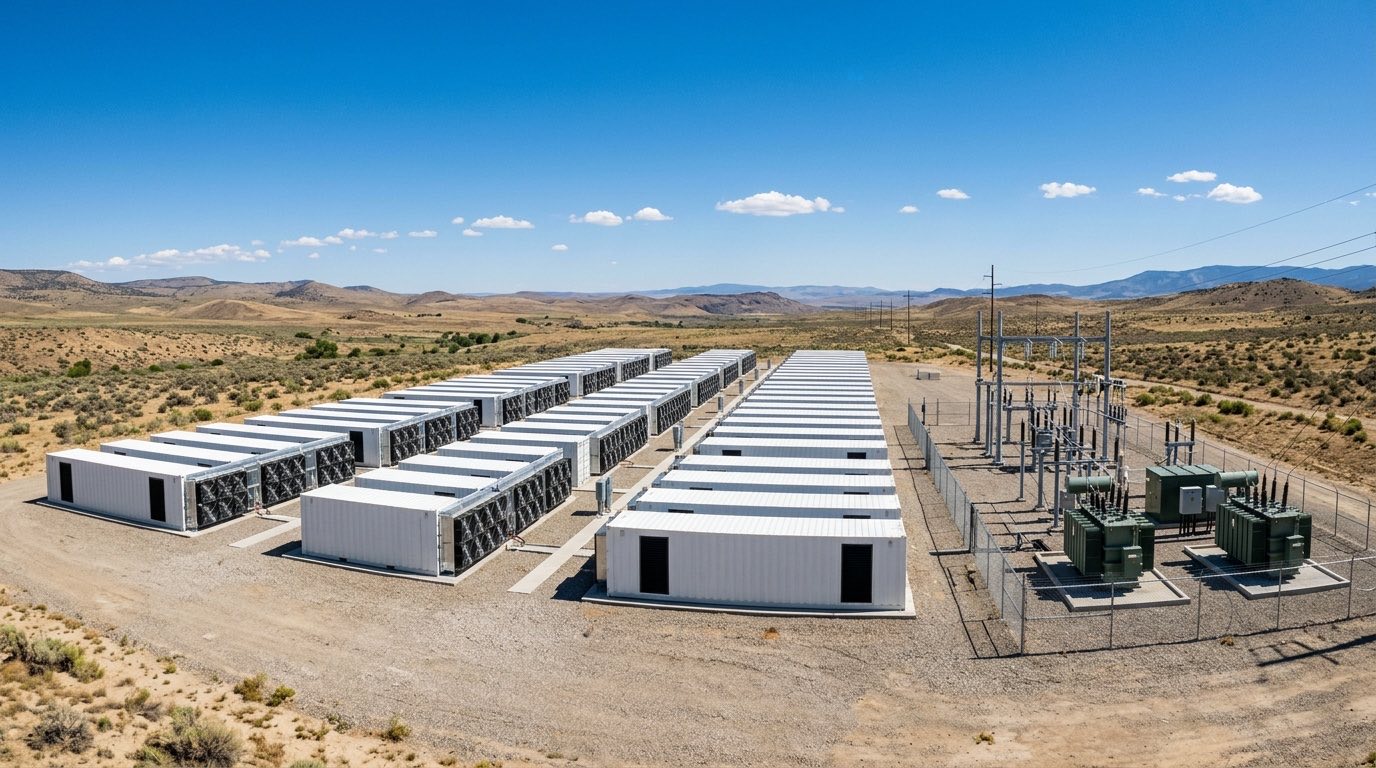
On January 9, 2026, NERC, the North American Electric Reliability Corporation, published an incident review titled "Voltage-Sensitive Crypto Load Reductions." It looks at crypto-mining facilities on the grid of ERCOT, the Electric Reliability Council of Texas, that dropped load when a normally cleared fault on a transmission line made the voltage sag. And it sets those facilities apart from cloud and AI data centers.
Crypto facilities, the review says, differ from "cloud computing and AI data centers, in that they typically do not have uninterruptible power supply (UPS) systems or backup generators." As a result they have "different ride-through characteristics."
Load Lost in Milliseconds
"ERCOT identified 26 LEL ride-through events involving indirect load loss greater than 100 MW from one or more crypto facilities between January 2023 and September 2025." LEL is the review's short form for large electronic loads. Indirect, in its footnote, means loss "not directly attributable to the outage of the electrically connecting line during the fault, arising instead from system or grid effects." The reductions "varied from approximately 17% to 95% of pre-disturbance consumption."
Its summary of incidents adds a warning. "If blockchain/crypto-mining load continues to grow in the ERCOT Interconnection, this load loss could grow to a level that would threaten the reliability of the Interconnection."
Why a Site Drops
The review traces the drops to the facilities' own equipment, their constant-power supplies, cooling and single-phase devices. The power supplies in a crypto facility are constant-power devices, so when the voltage falls the current they draw rises in proportion. Some facilities tripped their main distribution breakers on that rise in current, "during a very short duration (50 milliseconds) voltage depression." The equipment is also "largely single-phase," and a dip on one phase leaves the currents unbalanced. "In multiple instances," the review says, neutral overcurrent protection "has tripped the entire facility" because of that imbalance during a normally cleared fault.
Cooling can take a site down on its own. Much of the cooling load runs on variable frequency or variable speed drives with their own low-voltage protection. "In one instance, the undervoltage trip thresholds of the VFD/VSD equipment were set as high as 0.96 p.u.," p.u. being the review's short form for per unit, and a dip of 50 milliseconds then cost the cooling load. "Once cooling is lost, the cryptocurrency facility can rapidly overheat, ultimately forcing a complete shutdown."
"Given the critical role of ride-through requirements," the review says, ERCOT "is planning to introduce such requirements related to cooling system load." The recommendations the review says "should be considered" are to review manufacturer default undervoltage settings on the drives, to adjust protection thresholds or implement UPS on control circuits and drives, and to ensure that ride-through coordination between IT and mechanical systems is part of the facility's reliability design.
An undervoltage setting on a cooling drive cost a facility its cooling load in one instance, and the review's first recommendation is to check the manufacturer's defaults. For an AI campus the same question belongs in commissioning. Which device trips first when the grid dips?
Coming Back, and What May Change
"Based on observed disturbance events, restoration times across crypto facilities vary significantly." In one worked example, a lightning strike on 138 kV lines affected two facilities. One "required nearly two hours to return to normal consumption." At the other, "Load was fully restored in approximately five minutes." In every recorded case the return was gradual, because "recovery occurs through a restarting process, not from instantaneous transfer via UPS as seen in traditional data centers."
The review then looks ahead. "As some crypto facilities transition toward AI or cloud workloads, load behavior, ride-through characteristics, and use of UPS systems may change," it says, and interconnection requirements "may need updates for evolving load types." Some facilities have improved their ability to withstand single-phase faults, but those enhancements "are unlikely to address multi-phase fault conditions, which can lead to deeper and more prolonged voltage depressions that most installed systems cannot handle." Proposals to put ride-through requirements for large electronic loads into ERCOT's operating guides and protocols "are undergoing the ERCOT stakeholder process."
The review says load behavior "may change" as some sites move toward AI work, and it does not say in which direction. A lender looking at a converted site would want to know which behavior it was built for, and what the grid operator's rules would ask of it.
Sources
- North American Electric Reliability Corporation (NERC). Incident Review: Voltage-Sensitive Crypto Load Reductions. 9 January 2026. regulator