Eight times a year the Federal Reserve publishes the Beige Book, a summary of what contacts across its twelve districts report about their local economies. The Beige Book whose cover reads "August 2026" was prepared at the Federal Reserve Bank of Minneapolis "based on information collected on or before August 24, 2026." Its material is "a variety of mostly qualitative information, gathered directly from each District's sources," and the report says whose words these are. It "summarizes comments received from contacts outside the Federal Reserve System and is not a commentary on the views of Federal Reserve officials." Data centers come up in several districts' sections, and some of those passages follow.
Where the building is
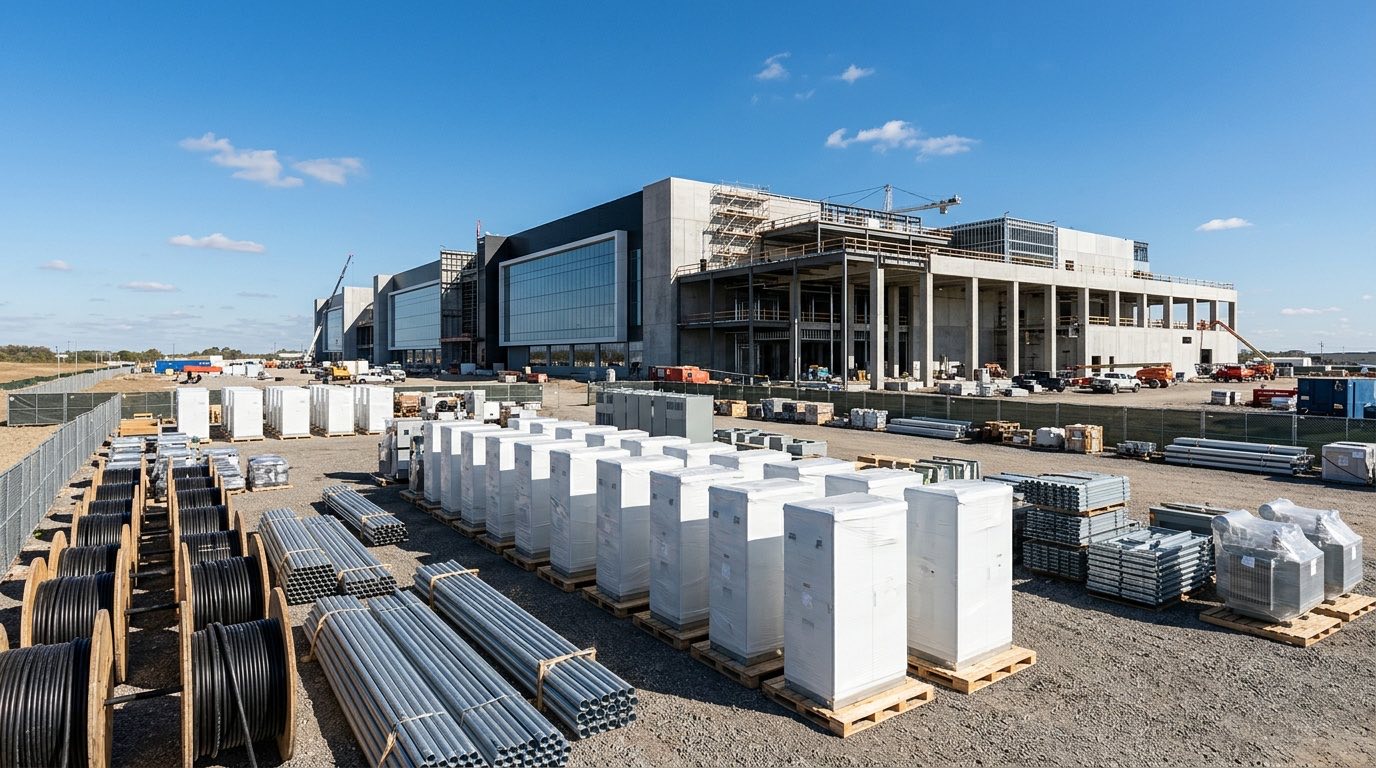
Across the country, the summary says, nonresidential construction increased on balance, "with some Districts noting a high concentration of activity related to data center projects." Chicago's section reports nonresidential construction unchanged, with data center and other mega-site construction projects "the main centers of activity." One contact there said that "without data centers, construction would be in a recession." That is one contact, in one district. St. Louis's section says "Construction activity is slowing outside of data centers," and Minneapolis's that nonresidential activity "remained highly concentrated in infrastructure and data center projects."
Contacts in the Richmond Fed's district raised a worry. "Data center moratoriums raised alarms, particularly in the DMV area where contacts worried about a slowdown in construction and capital investments." A slowdown is what they feared.
A moratorium is a pause a developer does not control. The report records the alarm and the fear of a slowdown, and for a project in such an area that is a schedule risk to price in.
Crews and metal
The same Richmond section says that "The skilled labor pool remained tight," and that data center construction "has further strained labor availability, with contacts reporting increased competition from non-local companies pursuing data center work." It adds that one Maryland construction company "implemented a 35 percent pay increase as a retention strategy." One company, in one district.
Minneapolis's section reports that "Several contacts noted increased worker demand in construction and manufacturing related to data center development." On materials, its paragraph on construction says that more than half of the contacts in it "reported paying modestly higher prices for inputs with further price increases expected in the coming weeks," and that "Less than half of contacts reported increases in their own pricing."
Between those two lines, the section quotes a builder working on multiple data center projects, who said that announced price increases for aluminum and steel "ranged from 5 to 10 percent." Announced increases, from one builder.
Speed to power
On energy, the Kansas City Fed's section says contacts in the power and renewables sector "reported historically strong electricity demand, driven by growing data center development." They further noted that price-insensitive technology companies are more concerned about speed to power, a phrase the report sets in quotation marks, than about the price of power.
The section then describes the projects. "Many new data center projects include co-located generation, resulting in higher power costs and longer project timelines, as manufacturers reach production capacity limits." Higher costs and longer timelines, together. Contacts are adapting, it says, to "labor, supply chain, and permitting constraints by vertically integrating operations and reducing the size of power developments to shorten project timelines."
The buyers these contacts describe put speed ahead of price, and many new projects with co-located generation bring higher power costs and longer timelines. A lender would ask of any one project whether it gets the speed it is paying for.
On prices, many contacts anticipate higher power costs in the coming years, though some noted that increases in consumer electricity prices "remain uncertain, as the cost of new generation and power infrastructure is spread across rate payers." The section adds that "In some locations, adding new generation can lower average costs for retail customers due to improved economies of scale."
Sources
- Federal Reserve System. The Beige Book: Summary of Commentary on Current Economic Conditions by Federal Reserve District, August 2026. August 2026. central bank